
The topic U.S. lifts Iran oil sanctions. And, federal judge rules SAVE voter tool unlawful is drawing steady attention: readers, analysts, and industry watchers are all tracking how the story may unfold in the days ahead.
This is taking place in a fast-moving context — product cycles, platform shifts, and competitive moves can reshape the outlook quickly, so the details below are worth a careful read.
What follows is a clear walkthrough of the main facts and angles you need to make sense of the news.
The United States has temporarily lifted oil sanctions on Iran, allowing the country to sell its oil in U.S. dollars on the global market. This temporary measure enables Iran to sell freely at standard prices, as other major Gulf oil producers do. The 60-day sanctions exemption is part of several economic incentives intended to benefit Iran.
Vice President Vance waves as he boards Air Force Two as he leaves Switzerland after meeting with representatives from Iran to negotiate details of their peace agreement at Emmen Air Base, near Lucerne, on June 22, 2026. Nathan Howard/Pool / AFP via Getty Images hide caption
President Trump is traveling to Lehigh Valley, Pa., today to tour a Mack Trucks manufacturing plant and promote his economic achievements. This marks his first domestic trip since signing an agreement with Iran to end the fighting in the Middle East. During this visit, the president has the opportunity to shift attention back to his domestic agenda, especially as he faces low approval ratings. according to the data NPR’s recent polling, just 36% of voters approve of Trump’s overall job performance, while 59% disapprove.
In Minnesota, a federal judge dismissed grand jury subpoenas issued by the Trump administration, ruling that they aimed to harass, coerce and retaliate against state officials who resisted the federal government’s immigration policies. The judge sided with the arguments of Minnesota state and city officials, who said that the subpoenas violated the 10th Amendment, which prevents the federal government from compelling or intimidating local governments into adopting specific policies.
A federal judge ruled yesterday that the Trump administration’s project to aggregate Americans’ personal data to check voter eligibility is unlawful. As a result, the data tool known as SAVE cannot be used in its current form. Several states have already processed their entire voter lists through the system, which the Trump administration overhauled last year. While the tool aims to identify potential noncitizens and deceased voters, it has mistakenly flagged a number of U.S. citizens who are foreign-born as potential noncitizens. NPR was the first outlet to report on the federal government’s expansion of SAVE to use it as a tool to check the citizenship of all Americans, and on how the government failed to follow the required public notice protocols under the Privacy Act.
As we approach the end of the group stage, when 12 teams will be cut, let’s take a moment to appreciate the array of jerseys that have graced the field.

Every World Cup, teams unveil a home and an away jersey. The purpose isn’t simply to tell squads apart, but to share a story about each country. To see this tournament’s best jerseys and the intention behind them, check out this roundup from WBUR.
[The cleats, meanwhile, have been mostly hot pink at the request of athletes wanting a bold color, according to the data The Athletic.]
Now, not every jersey made its debut. Haiti’s original shirt included a powerful image of the final battle of the Haitian War of Independence in 1803. But before the team’s opening match, FIFA rejected the design, deeming it too political, ESPN reported.
This year, the U.S. home jersey pays homage to the American flag’s red and white stripes.
But here’s a fun fact: The first time that the U.S. hosted the World Cup in 1994, team USA wore a faux-denim, star-covered shirt. The verdict?
” It was kind of universally hated at the time,” says Brian D. Bunk, who teaches the history of sports at the University of Massachusetts Amherst.
Left: The NPR’s Juliana Kim in her 1994 vintage jersey. Right: Malik Tillman of USA in action in this year’s kit. Juliana Kim/NPR (left)/ Stu Forster/Getty Images (right) hide caption
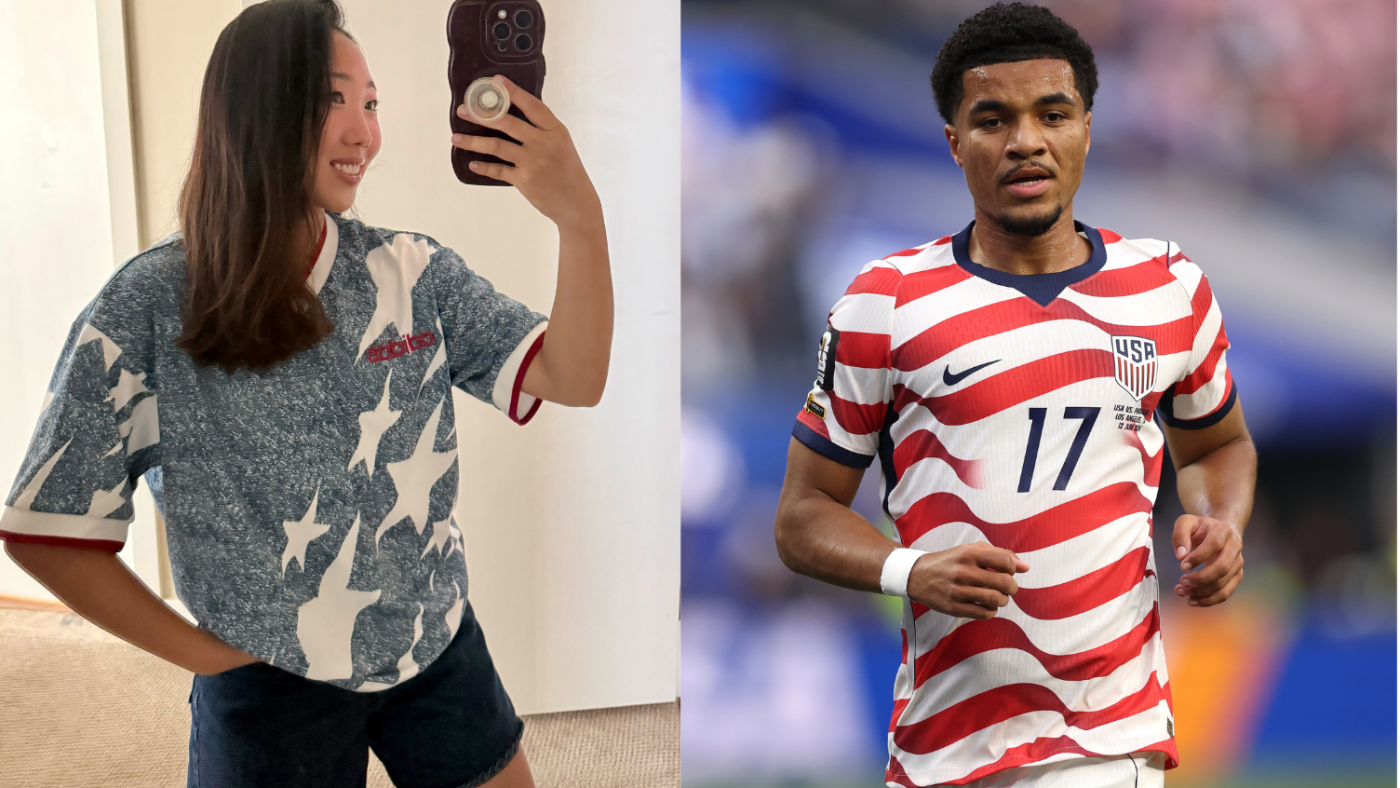
The kit was designed by Peter Moore, the same artist who crafted the first pair of Air Jordans and the iconic Jumpman logo. While the soccer jersey was initially seen as a miss, it’s now adored by fans who consider it retro.
Bunk says it’s one of those rare cases in fashion trends where the jersey was “so bad that it was good.”
Click through to watch the latest Soccer Edition video clips from across the NPR Network.
Sports in America: Why the U.S. Men’s Team Has Never Won the World Cup
The 2026 FIFA Men’s World Cup is in full swing — but unlike the U.S. women’s team, the men’s national team has never won the tournament. They’ve never even made it to the finals. WHYY’s Sports in America sits down with ESPN soccer writer Ryan O’Hanlon to figure out why the men’s team always falls short. Could this year’s World Cup be any different?
⚽ This week we’re rounding up the Group Stage. Team USA will play Turkey in LA on Thursday. Iran just wrapped up their first two games at the Los Angeles Stadium and LAist’s Imperfect Paradise took a closer look at what the World Cup has been like so far for Iran. NPR’s State of the World heard from folks in Tijuana, Mexico, about hosting Team Iran, as they navigate complications with the U.S.
⚽ Cinderella moments and mighty minnows: Congo’s team, playing in the World Cup for the first time in more than half a century, is scheduled to play Colombia tonight. As Houston Public Media reports, holding their own against Portugal in their last match felt like a win to the Congolese diaspora. Meanwhile in Kansas City, the tournament “minnows,” underdog Curaçao tied with the heavily favored Ecuador. And as KCUR reports, fans of both teams considered it a win. Both teams have their next match on Thursday.
Sister Mary Consulata assists an elderly nun as she takes tea at the Little Sisters of St Francis premises in Nkokonjeru, Uganda on May 12, 2026. The interaction takes place within the dining area of the congregation, where retired sisters are supported through daily routines. The Little Sisters of St Francis, a longstanding religious congregation in Uganda, provide ongoing care for aging members who require assistance with meals, mobility, and medical needs. Many of the elderly sisters have spent decades serving in education, healthcare, and community outreach across the country and now live within the convent under structured care and support. Stuary Tibaweswa for NPR hide caption
The Little Sisters of St. Francis convent in Nkokonjeru, Uganda, cares for retired nuns. But there is minimal funding for palliative care, which offers medical and emotional support to patients nearing the end of their lives. At the convent, young nuns look after the retired nuns, helping them move to and from their beds and serving their meals. The older women lack important resources, such as adult diapers, wheelchairs, hearing aids and warm blankets. To address these challenges, Sister Jane Frances Nakafeero and Jean Callahan, who is an advisory board member of the African Palliative Care Association, started a pilot program to provide hospice support for aging nuns. Launched in September 2025, the program aims to address the nuns’ medical and material needs. It will also offer psychological interventions for emotional support and mental stimulation. Take a look at how these nuns help each other.
Clive Davis in 2026 Leon Bennett/Getty Images for The Recording A/Getty Images North America hide caption