
The topic Disinherited half-sister of singer who co-wrote Shaggy’s ‘It Wasn’t… is drawing steady attention: readers, analysts, and industry watchers are all tracking how the story may unfold in the days ahead.
This is taking place in a fast-moving context — product cycles, platform shifts, and competitive moves can reshape the outlook quickly, so the details below are worth a careful read.
What follows is a clear walkthrough of the main facts and angles you need to make sense of the news.
The half-sister of the singer who paired up with Shaggy for his 2000 hit ‘It Wasn’t Me’ has been handed a £126,000 court bill after losing her claim to a share of their father’s £1million fortune.
Sarah Ducent, the half-sister of British-Jamaican vocalist Rickardo ‘Rik Rok’ Ducent, 52, took his mother, Dorothy Ducent, to court in a bid to ‘reasonable provision’ from her father’s estate, claiming she was living in poverty in London.
Herbert Ducent, who died aged 63 in 2007, left the bulk of his £900,000-plus estate to his widow Dorothy. He cut out his daughter Sarah, from whom Rik said he had become ‘estranged’ – something she denies.
Herbert was an entrepreneur who established a successful construction company in Jamaica, as well as running a thriving bakery business in Coldharbour lane, Brixton. His estate is made up of assets in London and Jamaica.
Dorothy, who had worked alongside Herbert in his south London bakery business, inherited his wealth under a will drawn up in Jamaica.
Sarah’s claim to the estate was dismissed by a judge at Central London County Court, who demanded she pay £126,000 towards Dorothy’s legal costs.
The former civil servant challenged the six-figure bill in the same court last week, calling the sum ‘excessive’ and ‘disproportionate’.
But Dorothy’s lawyers defended issuing a default costs certificate against Sarah, a court document fixing the amount owed after a party fails to challenge legal costs within the required timeframe.
Shaggy (left) and Rik Rok rehearse at the 2002 American Music Awards at the Shrine Auditorium in Los Angeles
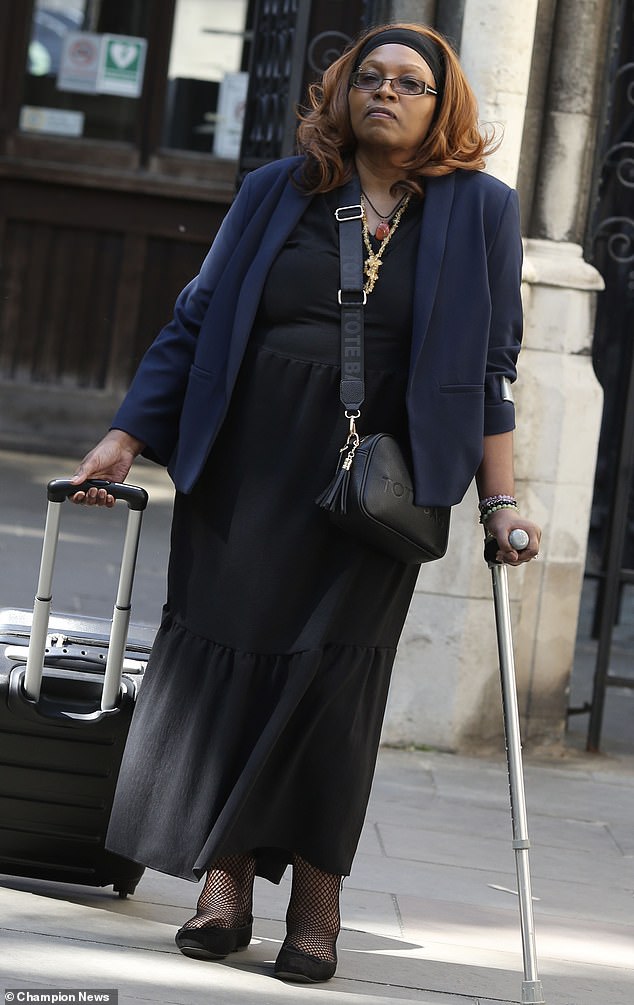
Sarah Ducent, the half-sister of Rik Rok, is pictured outside Central London County Court
Herbert Duncent, who died aged 63 in 2007, left most of his £900,000-plus estate to his widow, Dorothy Duncent (pictured). Dorothy is Rik Rok’s mother

They highlighted Sarah’s past non-compliance with court orders, including a previous order that she pay £40,000 towards Dorothy’s legal fees that never materialised.
Judge Jane Evans-Gordon rejected Sarah’s bid to ‘set aside’ the order. She found there were no solid grounds to challenge the bill, while accepting Sarah ‘just doesn’t have that sort of money’ to pay.
‘I am not going to set aside the default costs’ certificate, I am not satisfied that £126,000 for a dispute of this nature is plainly disproportionate,’ she said.
‘There was a three-day trial and there have been a number of hearings. It was also an international case in the sense that it involved witnesses from overseas.
‘The deceased had been domiciled and resident in Jamaica for many years and much of the evidence had to come from there.’
At least one witness had to give video evidence from Jamaica, the judge said, adding that Rik, also had to fly in to give evidence.
‘I cannot say that £126,000 is disproportionate in all the circumstances,’ she said.
‘I see a great many costs orders, some of which are positively eye-watering, and I’m afraid that this is not such a figure. Her inability to pay is irrelevant to the question whether this costs order should be made.’
The English estate mainly consisted of two neighbouring properties in Peak Hill, Sydenham, jointly valued at around £900,000 (pictured)
Herbert’s English estate mainly consisted of two neighbouring properties in Peak Hill, Sydenham, jointly valued at around £900,000, with more property forming his Jamaican estate.
In her bid to claim ‘reasonable provision’ from his fortune, Sarah was asked to prove that Herbert’s legal permanent home was London, not Jamaica.
Herbert moved the family to Jamaica in 1983, with Dorothy moving back to London in 1996, after which Herbert never visited England again.
A judge ruled that Herbert was domiciled in Jamaica at the time of his death.
During the case last year, Rik was asked by Sarah’s barrister, Oliver Ingham, about his father’s relationship with Sarah.
‘It’s not correct that after leaving Jamaica to come to the UK for college she was estranged from Herbert or that she cut off relations with him,’ Mr Ingham put to him.
‘That’s what he told me,’ Rik replied, also claiming that a family friend with whom Sarah was lodging had called Herbert to ‘complain to my father about her behaviour’.
‘On his next trip to the UK, he confronted her about it and an argument ensued. My father told me that she declared she wanted nothing more to do with him and he said “are you sure that’s what you want because if we’re done we’re done”,’ he said.
Outside court last year, Sarah said she was living ‘on the breadline’ and that any cash from her father’s estate could transform her life.
‘I am hurt by the whole thing and I’ve lost my whole family,’ she said.
‘My dad died, but on the day he died I didn’t think I would end up being in the position I am today, going through all this heartache.
‘I don’t have a step-mother anymore. This money would make a great difference in my life, I am on the breadline right now.’
Rik co-wrote the much-loved 2001 UK number one with Shaggy and sang the main vocals on the track, which went beyond one billion plays on Spotify and had sold nearly 1.5million discs by 2017.
In interviews, Rik, who grew up in London and rural Jamaica, has explained how his love of music was sparked by hearing his parents sing, naming his dad as an inspiration and a ‘big reggae fan’.
He has said he never gets tired of playing ‘It Wasn’t Me,’ which brought about a major life change for him.
‘I was finally able to silence the detractors who thought I was wasting my life on this music nonsense and I also made my parents very proud,’ he told the Jamaica Observer in 2023.
‘I was able to travel the world and see places it’s doubtful I would’ve seen otherwise.
‘Over two decades later, I still get recognised [and] can’t count the number of pictures I’ve taken and autographs I’ve signed for the nicest strangers you could ever meet. It’s allowed me to basically retire and focus entirely on raising my beautiful family. Eternally grateful for that.’