The topic Finance expert’s ‘jaw drops’ over claim in Jim Chalmers’ Budget… is drawing steady attention: readers, analysts, and industry watchers are all tracking how the story may unfold in the days ahead.
This is taking place in a fast-moving context — product cycles, platform shifts, and competitive moves can reshape the outlook quickly, so the details below are worth a careful read.
What follows is a clear walkthrough of the main facts and angles you need to make sense of the news.
Treasurer Jim Chalmers has sensationally revealed the major tax changes in Federal Budget 2026 – including axing negative gearing, except for newly built properties, and reform of the Capital Gains Tax (CGT) discount.
The Albanese government will also introduce a new $250 annual tax offset – but it will not kick in until 2027 – and sweeping cuts to the National Disability Insurance Scheme.
‘This is the most important and ambitious budget in decades,’ Chalmers told the House of Representatives, just after 7.30pm, pointing to the Iranian fuel crisis.
The Treasurer claims the property tax changes – the most significant in 25 years – will help 75,000 young Australians in becoming first home-owners.
In his speech, he confirmed: ‘We’ll limit negative gearing for residential property to new builds from July next year.
‘And we’re replacing the 50 per cent capital gains tax discount with inflation-adjusted indexation, to restore the taxation of real gains.’
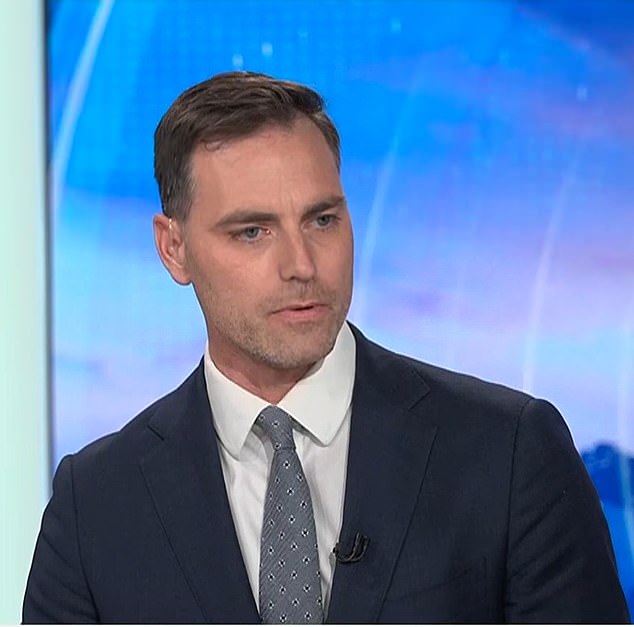
Financial journalist Chris Kohler said his ‘jaw dropped’ following the Albanese Government’s claim that rents could rise by a modest $2 a week.
Mr Kohler, who was appearing on Channel Nine’s budget breakdown on Tuesday night, said it was this figure that stumped him while going through the budget papers.
‘In there, it states that (the government) estimate that as a result of this $2 a week increase in rents, I don’t see how that’s possible. It seems clear that if you make rental properties more expensive to own, then the rent will go up significantly,’ he said.
9News Money Editor Effie Zahos added: ‘You can bet your bottom dollar that if we had people from the Property Council here, they’d be saying rents will be going through the roof!’
It comes as Treasurer Jim Chalmers told Parliament his changes to the Capital Gains Tax (CGT) discount and negative gearing would help 75,000 more Australians into their first home.
The tax reform package is expected to reduce investor demand, with the government claiming in its budget papers that ‘the reforms are likely to have a small impact on rents, with an expected increase of less than $2 per week for households paying the current median rent.’
The paper continued: ‘Treasury modelling suggests housing prices will temporarily grow by around 2 per cent less over a couple of years relative to no tax policy change. For comparison, on average prices have grown by 6 per cent a year since 2000.’
An economist has slammed the Albanese government’s migration forecasts, warning a fresh surge in arrivals revealed in the federal budget will worsen Australia’s housing crisis and increase pressure on renters.
New budget figures released on Tuesday project nearly 765,000 permanent migrants will come to Australia over the next three years, a trend economist Leith van Onselen says will deepen the nation’s housing shortage.
The budget shows net overseas migration will reach 295,000 in the current financial year, followed by 245,000 in 2026-27 and 225,000 in 2027-28.
Anthony Albanese’s government has confirmed more than 160,000 people will be kicked off the NDIS – as the scheme’s costs blow out of control.
The Albanese government confirmed in April that changes to eligibility rules would seek to lower the number of Australians on the scheme from 760,000 to 600,000 by 2030.
The scheme has previously been projected to cost about $49billion this financial year – and is now more expensive than Medicare.
As more people are diverted away from the NDIS, the government is aiming to divert children with autism who have low to moderate support needs onto the Thriving Kids program.
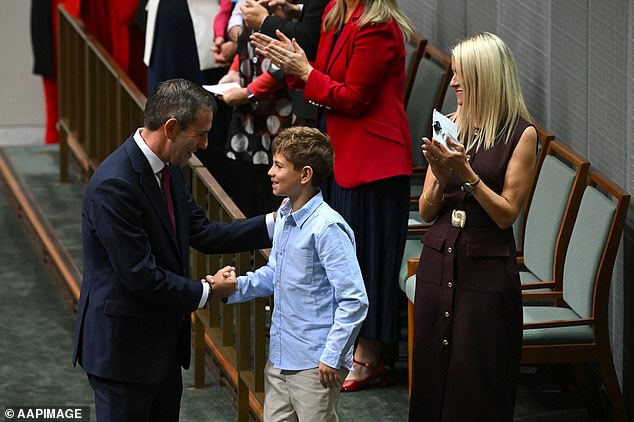
Jim Chalmers’ glamorous wife Laura and eldest son Leo were in Parliament House on Tuesday night to support him as he delivered his fifth Budget address.
The Treasurer could be seen approaching Laura and his son following the address as they cheered in support.
Laura, who has been criticised for her luxurious fashion choices at previous budgets, wore a modest yet stylish $119 brown dress from Zara.
She was slammed as ‘tone deaf’ at Chalmers’ 2024 budget speech, which was all about the cost of living, after she turned up wearing a $1,900 outfit.
The pair were sat next to Anthony Albanese’s wife, Jodie Haydon, and his son Nathan, who the Prime Minister shares with former NSW Deputy Premier Carmel Tebbutt.
Shadow Treasurer Tim Wilson has described the Albanese Government’s budget as ‘weird’ while claiming it will ‘kneecap young Australians’ wanting to buy their first home.
‘The government has put forward a budget about broken promises, higher taxes, lower living standards and fewer homes,’ Wilson told ABC’s Sarah Ferguson on Tuesday night.
‘We set three basic tests, to restore the standard of living, the reality is the standard of living has gone backwards under this government and real wages back by 3 per cent.
‘We set a test around building Australia’s security – it has less spending on defence from 2.1 to 2 per cent of GDP, and we set a test that was fundamentally about making sure that we saw a better outcome for Australians and honesty in the budget.’
Wilson also claimed the only honest point in the budget was Labor’s admission there had been few homes built over the last decade while rents soared.
‘When you look through the other measures they are introducing, including Capital Gains Tax, if you seek to invest your home deposit to buy your first home, the government will increase the taxes on that,’ Wilson said.
‘And so they are knee capping young Australians, who want to get ahead, save for their future and be in a better position to buy their own home.’
Wilson said the Coalition will refuse to support any of the government’s housing measures.
The Australian Taxation Office is set to significantly expand its workforce, adding nearly 1,500 staff as part of a broader push to crack down on fraud and strengthen the integrity of the tax system.
Budget papers show the ATO’s headcount will climb from 19,938 to 21,410 over the next financial year.
Treasurer Jim Chalmers told Daily Mail additional staff will underpin a new wave of compliance activity and fraud detection measures, as the government intensifies its efforts to close gaps in the system.
The increase coincides with the rollout of Phase 2 of the government’s Counter Fraud Strategy, which aims to modernise how fraud is identified and prevented across both tax and superannuation systems.
In what could spell as a worrying sign for the Albanese Government, the phrase, ‘uncertainty’ is featured 54 times in the main Budget book.
It comes as the Treasury acknowledged Australia’s economic outlook largely rests on the Iran War, with concerns inflation could remain consistently high, even hitting seven per cent if the price of oil doubles.
‘Heavily dependent, heavily hostage to developments overseas,’ Chalmers described the situation to reporters in the pre-budget lock up.
It was a theme Chalmers continued to touch on in his budget address, noting the budget was being delivered in ‘a time of extreme uncertainty and volatility in the world.’
‘Oil production fell by eight million barrels a day in the first month of the war – almost eight times more than any of the oil shocks since the 1970s. The global oil price started the year around $60 and has now been above $100 for the bulk of the past two months,’ he said.
‘A third of the world’s seaborne fertiliser has been stuck, putting pressure on food production, food security and supermarket prices.
Unless you buy a newly built house or apartment you must have already own your negatively geared older property to benefit from the tax deduction.
Future investors will be dragooned into buying new, if they also want to benefit from.
If you’re wondering if you are allowed to knock down an existing older property and build a new one, thereafter enjoying the benefits of negative gearing, the answer is a firm no.
The Treasurer has described the Federal Budget as the most ‘important and ambitious budget in decades’, pointing to global instability as a key driver behind the Government’s approach.
‘That’s why this Budget invests in resilience and reform, to grow our economy the right way and lift living standards over time. We’ll do that through three ambitious policy packages – a productivity and investment package, a tax reform package and a savings package as well,’ Chalmers said.
‘This productivity package will help us attract and absorb more investment, make it easier and quicker to build, and it will slash compliance costs. The reforms we are announcing tonight will cut regulatory costs by $10.2 billion every year.’
Chalmers said the government will cut ‘unnecessary’ red tape, make tax time simpler for small business and get rid of nearly 600 tariffs to reduce trade barriers.
Jim Chalmers has confirmed negative gearing will be axed during Tuesday’s Federal Budget address.
Chalmers claimed the changes will help around 75,000 Australians to ‘achieve the dream of home ownership.’
‘We’ll limit negative gearing for residential property to new builds from July next year,’ Chalmers said.
‘And we’re replacing the 50 per cent capital gains tax discount with inflation adjusted indexation, to restore the taxation of real gains.’
Treasurer Jim Chalmers has started his Federal Budget address at Parliament House in Canberra.
There’s five minutes to go until Jim Chalmers delivers the Federal Budget address at Parliament House in Canberra.
He will then race off for his first formal interview post-budget with ABC’s Sarah Ferguson.
The Daily Mail will have all the major announcements here, including details of the key commitments, the winners and losers, and analysis from Daily Mail’s political editor Peter Van Onselen.